
Which Platforms Were Hit Hardest in August’s $163M Crypto Exploits?

Key Insights:
- $163M lost in the crypto market in August, up 15% from July.
- Btcturk hacked again, losses now top $100M.
- Biggest hit: $91.4M from one Bitcoin wallet.
- 16 major exploits show rising crypto security risks.
Crypto investors returned from summer to sobering news: August 2025 saw a sharp uptick in security breaches.
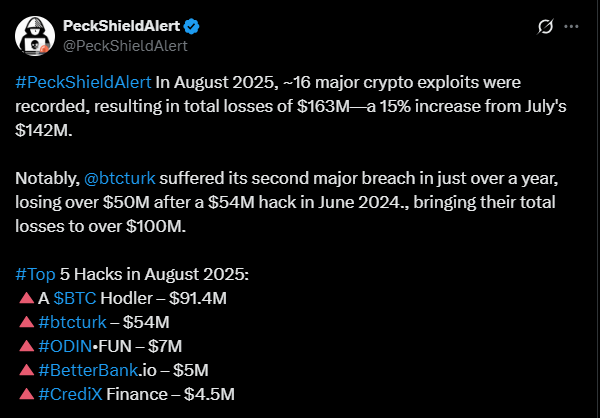
According to blockchain security firm PeckShield, roughly $163 million was stolen in 16 crypto hacks during the month – a 15% jump from July’s $142M total.
The losses were concentrated in a few high-profile incidents spanning exchanges, DeFi protocols and even individual wallets. For comparison, first-half 2025 hacks have already totaled over $2.3 billion.
Biggest Crypto Exploits in August
Key targets in August included both centralized exchanges and DeFi projects. The top five exploits by loss were:
- Individual Bitcoin holder – $91.4M lost in a scam.
- BTCTurk (Turkey’s largest exchange) – $50M (second major breach, bringing its total thefts above $100M).
- ODIN.fun – $7M drained from a Bitcoin-based memecoin launchpad via an AMM exploit.
- BetterBank.io – $5M stolen from a PulseChain lending protocol through a reward-minting flaw.
- CrediX Finance – $4.5M hijacked from a new Sonic-chain DeFi platform in a multi-sig wallet exploit.
Each of these cases highlights different vulnerabilities. For example, BTCTurk – which holds large user deposits – saw attackers compromise its hot wallet private keys and siphon about $48–54M on Aug. 18.
Blockchain monitors flagged roughly $48M moving out of BTCTurk wallets across Ethereum, Avalanche, Arbitrum and other chains.
The exchange immediately froze deposits and withdrawals, assuring customers that cold-held assets were safe.
This was BTCTurk’s second “hot wallet” hack in 14 months (it lost $55M in June 2024), so its cumulative losses now exceed $100M.
Crypto Market in Dire Shape
The alarm over BTCTurk’s breach underscores how even well-known platforms remain vulnerable.
Notably, the largest single loss did not come from an exchange: one longtime Bitcoin investor fell prey to a social-engineering scam that drained $91.4M from his wallet.
This shows that sophisticated phishing and key-theft attacks are “equally risky for individuals and institutions,” as analysts warn.
Beyond these headline cases, smaller projects also took hits. DeFi protocols were exploited for millions: ODIN.fun, a Bitcoin “meme token” launchpad, lost about 58.2 BTC ($7M) when attackers manipulated its liquidity AMM logic.
BetterBank.io, a PulseChain lending platform, had $5M drained after hackers created fake liquidity pools to game its bonus-reward system.
And CrediX Finance – a nascent Sonic-chain lending service – was taken offline after a $4.5M breach.
Security firm CertiK noted that the CrediX funds were quickly bridged from Sonic to Ethereum to obfuscate the trail.
PeckShield highlights that these multi-chain laundering techniques are common: many August thefts used mixers and cross-chain bridges to hide stolen funds, patterns “consistent with North Korea’s Lazarus Group” tactics.
Crypto Market Context and Outlook
These hacks come amid robust market activity and growing institutional interest. In fact, August 2025 saw record trading volumes on decentralized platforms – DEXs processed about $1.15 trillion in spot and perpetual volume, first time passing $1 trillion.
Perpetual futures alone jumped to $648.6B in August (up 31% from July). Meanwhile, traditional markets were also active: Bitcoin hovered around $108K (after peaking near $124K in early August).
Strong ETF flows reflect this institutional demand. For example, Bitcoin ETFs absorbed 3,000 BTC in the first week of September – evidence that “institutional demand remains strong” despite a late-August pullback.
Smaller altcoin ETFs saw big inflows too – e.g. Solana and XRP ETFs saw $177M and $134M in August flows.
However, the rising attack losses underscore fresh risks. Analysts note that higher crypto prices may be emboldening hackers.
The persistence of billion-dollar breaches (Bybit’s $1.4B hack in 2025, Cetus Protocol’s $225M, etc) is “fueling calls for stronger compliance and security standards” across both exchanges and DeFi platforms.
On-chain analytics reveal a migration of criminals: state-linked groups reportedly “frequently” use mixers and bridges to move stolen crypto within hours.
This has prompted regulators and industry groups to push for tighter safeguards – from mandatory multi-signature custody to more rigorous audits and “red-team” tests.
The post Which Platforms Were Hit Hardest in August’s $163M Crypto Exploits? appeared first on The Coin Republic.